

Website care plans are ongoing services that keep your website secure, fast, and reliable. Think of it as a subscription for your site's health, handling all the technical stuff—updates, backups, security checks—so you can stay focused on your business.
Shifting from Cost to Investment

Many people treat their website like a one-and-done project. You build it, launch it, and that’s it. But that's a bit like buying a new car and skipping the oil changes, tire rotations, and tune-ups. Sooner or later, it's going to break down, and probably at the worst possible time.
A website care plan completely flips that reactive, "break-fix" way of thinking. Instead of paying someone to fix things after they go wrong, it's a proactive strategy to prevent those problems from happening in the first place. It's preventative medicine for your most important online asset.
The Employee Who Never Sleeps
Picture your website as your hardest-working employee. It's on the job 24/7, never calls in sick, and it’s usually the first impression a new customer has of your brand. Just like any key team member, it needs ongoing support to perform at its best.
Without that support, things start to go downhill. The site might slow down, become an easy target for hackers, or start showing strange error messages. A website care plan is like health insurance, performance coaching, and IT support all rolled into a single, predictable monthly package for that digital employee.
A proactive maintenance strategy doesn't just fix problems—it creates an environment where problems are less likely to arise. This consistent care is the foundation for a reliable and high-performing digital presence.
This change in perspective is key. You aren't just paying another monthly fee; you're investing in uptime, security, and peace of mind. It frees you up from worrying about plugin updates or potential hacks so you can put your energy where it matters most: growing your business.
What Proactive Care Actually Means
So, what does this proactive management look like day-to-day? Instead of a frantic search for a developer when your site suddenly crashes, a care plan automates the critical tasks that keep it running smoothly. For a more detailed look at the services included, you might want to check out our guide on building a comprehensive website maintenance plan.
This consistent attention covers several vital areas:
- Security: Regular malware scans and threat monitoring act like a digital alarm system, stopping intruders before they can cause any real damage.
- Updates: Your website runs on software (like WordPress core, themes, and plugins) that needs regular updates to fix security holes and maintain compatibility. A care plan handles all of that for you.
- Backups: Daily or weekly backups are your ultimate safety net. If the worst happens, your site can be restored in a flash, keeping downtime and data loss to a minimum.
- Performance: A slow website is a killer. It frustrates visitors and tanks your search engine rankings. Ongoing optimization keeps your site fast and responsive.
By taking care of these essential functions, a website care plan makes sure your digital storefront is always open, secure, and ready for customers.
The Anatomy of a Powerful Care Plan
A great website care plan isn't just a random list of technical chores. It's a structured system built on a few non-negotiable pillars, each designed to protect, maintain, and actually improve your site over time. When you understand these key parts, you start to see the real value you're paying for.
Think of it like owning a house. You need a solid foundation (backups), strong locks on the doors and windows (security), modern plumbing and wiring (updates), and a layout that's easy to live in (performance). If one of those elements is weak, the whole structure is at risk.
This infographic breaks down how a comprehensive plan delivers its benefits.
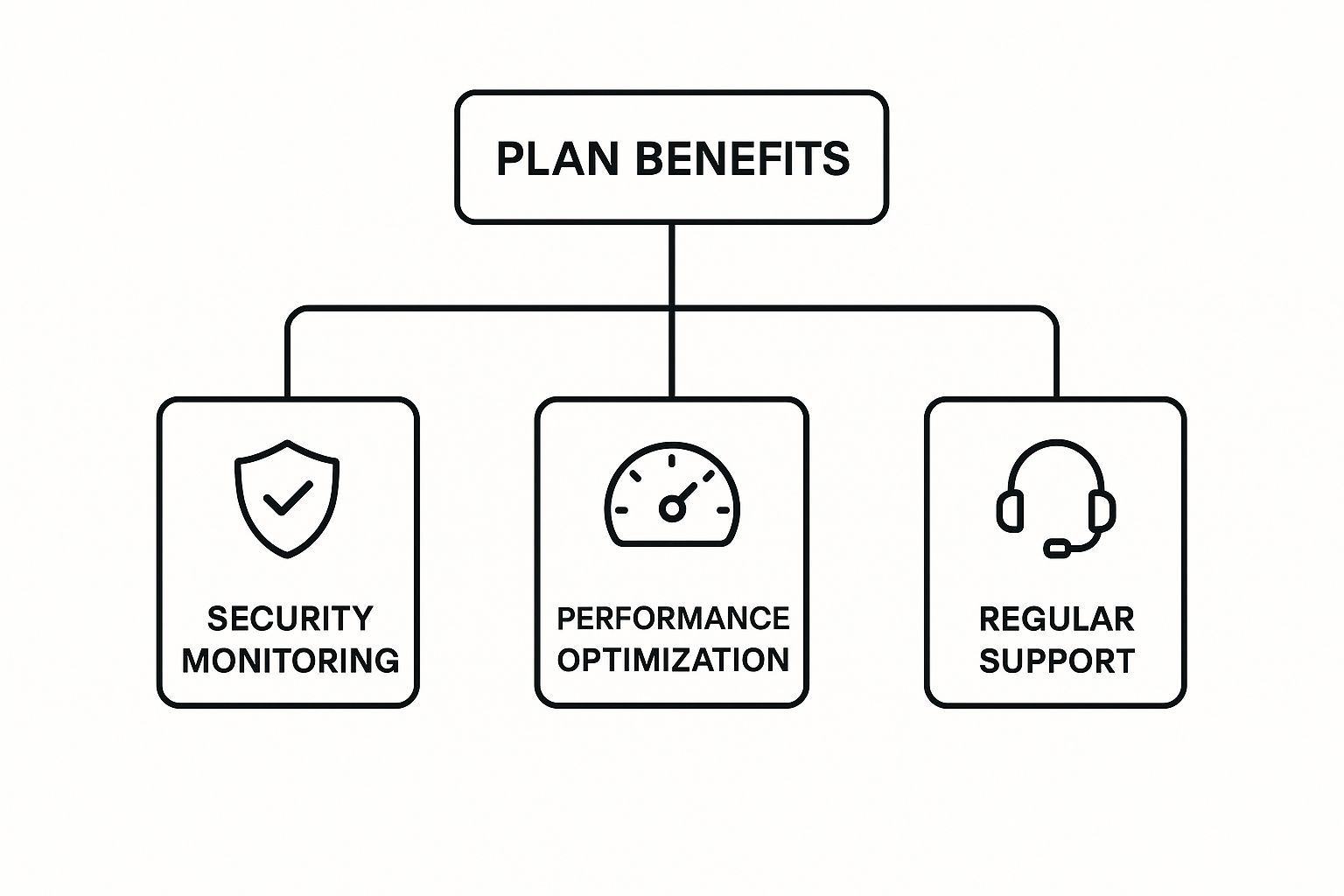
As you can see, everything stems from strong security, performance, and support—the core pillars that protect and grow your website's value.
Your Ultimate Safety Net: Daily Backups
The absolute bedrock of any care plan is a reliable backup system. Just imagine you accidentally delete a critical page, or a plugin update goes sideways and crashes your entire site. Without a recent backup, you could be looking at hours, even days, of downtime and a massive bill to rebuild what you lost.
A powerful plan includes automated, off-site backups. This means your site's data is copied and stored in a completely separate, secure location from your web server. That part is crucial. If your server gets hacked or fails, having your backups stored somewhere else ensures they're safe and ready for a quick restore.
The Digital Alarm System: Security Monitoring
Your website is out there on the internet 24/7, constantly being probed by automated bots, hackers, and malware. A robust security protocol is like a digital alarm system that's always on, actively looking for and stopping threats before they can do any real damage.
For any online business, proactive ecommerce fraud prevention strategies are a must-have to protect customer data and maintain trust.
This typically involves:
- Firewall Protection: This acts as a gatekeeper, filtering out malicious traffic before it can even reach your site.
- Malware Scanning: Regular sweeps of your website's files to hunt for any suspicious code or infections.
- Vulnerability Alerts: Keeping an eye out for known security holes in your software and flagging them so they can be patched immediately.
Security isn't a "set it and forget it" task. It's a continuous loop of monitoring, prevention, and response. A good care plan systematizes this process, so it's not just an afterthought when something goes wrong. It's far cheaper and less stressful to prevent a hack than to clean one up.
Patching the Armor: Timely Software Updates
Your website is built with software—WordPress core, plugins, and themes—that developers are constantly improving. These updates don't just add new features; they often contain critical security patches that close vulnerabilities discovered since the last version was released.
Ignoring these updates is like leaving a gaping hole in your digital armor. Hackers love targeting sites running outdated software because the weaknesses are well-known and easy to exploit. A key job of a website care plan is to manage these updates for you, often testing them in a staging environment first to make sure they don't cause any conflicts or break your live site. You can follow a detailed WordPress maintenance checklist to stay on top of all these essential tasks.
Fueling Growth: Performance Optimization
Let's face it, a fast and smooth website isn't a luxury anymore—it's what users expect. Performance optimization is all about making your site as quick and responsive as possible. This has a direct impact on user experience, conversion rates, and even your SEO rankings, as search engines like Google openly favor faster sites.
This piece of the puzzle involves several ongoing actions:
- Database Optimization: Cleaning out the junk from your site's database to keep it running lean and fast.
- Image Compression: Shrinking image file sizes without sacrificing quality, which dramatically improves page load times.
- Caching Implementation: Storing static versions of your pages to deliver them to visitors almost instantly.
This focus on constant, reliable digital management is a growing trend. The global care management solutions market was valued at around USD 18.68 billion and is projected to hit USD 46.12 billion by 2033. This growth is fueled by the same needs that website care plans address: the demand for secure, high-performing digital platforms.
The True Cost of a 'Do-Nothing' Strategy
Skipping website maintenance feels like a savvy way to save a few bucks, but it’s a lot like racking up debt on a high-interest credit card. That bill always comes due, and the final cost is almost always way higher than the small price of being proactive.
This "do-nothing" approach is a massive gamble, and the odds are definitely not in your favor. Every missed update, every ignored security alert, and every bit of unoptimized code adds another layer of risk. Your valuable business asset slowly but surely turns into a ticking time bomb.

The Downward Spiral of Neglect
Performance is usually the first thing to go. Your website, once snappy and responsive, starts to feel sluggish. Pages take an extra second or two to load, which might not sound like much, but the impact is huge. The data doesn't lie: even a one-second delay can cause a 7% drop in conversions.
As your site's speed drops, so does your ranking on Google. Search engines want to send their users to sites that provide a great, fast experience. A slow, buggy website sends all the wrong signals, pushing you down the search results until you're practically invisible to new customers.
Technical debt is the implied cost of rework caused by choosing an easy (limited) solution now instead of using a better approach that would take longer. With website maintenance, this debt compounds daily, leading to catastrophic failure.
The decay is so gradual that it's easy to miss until something breaks spectacularly, forcing you to deal with it.
When Disaster Strikes: The Financial Fallout
The most painful cost of doing nothing is sudden, catastrophic failure. Let's say your e-commerce site, which brings in about $2,000 per day, goes completely dark on a Monday morning. Maybe a plugin conflict, maybe a server crash.
The immediate loss is obvious: $2,000 in sales gone, just like that. But the real costs dig much, much deeper.
- Emergency Repair Costs: You'll need a developer, and their emergency rate is probably $150 per hour or more. A tricky fix could easily take 5-10 hours. That's another $750 to $1,500 added to the bill.
- Reputation Damage: When a customer finds your site is down, they don't just wait around. They head straight to your competitor. You've lost their trust, and many of them won't be back.
- Data Loss: If your last backup was a few weeks ago (or worse, never), you could lose customer orders, contact form entries, and all your latest content. It's a massive setback.
Suddenly, that single incident has cost you $4,000 or more, which completely dwarfs the cost of a full year on a proper website care plan. Getting ready for these moments is key. A great place to start is by having a solid recovery process mapped out. You can learn more by checking out this helpful disaster recovery planning template.
The Unseen Costs That Linger
Beyond the immediate financial hit, a neglected website creates long-term headaches that are harder to cure. A security breach, for example, isn't just about downtime. It can get your site blacklisted by Google, lead to data privacy fines, and do irreversible damage to your brand's reputation.
Cleaning up a hacked website is a nightmare. You have to find and kill the malware, patch the hole that let them in, and then start the long process of rebuilding your search rankings and customer trust. This reactive, "break-fix" cycle is both exhausting and incredibly expensive.
A proactive website care plan is designed to stop this entire chain reaction before it starts. It’s not an expense; it’s an investment in stability, security, and the future growth of your business.
How Smart Maintenance Drives Business Growth
Most people think of a website care plan as an insurance policy. It's a defensive move, a cost you pay to keep bad things from happening. And while that's partly true, it misses the bigger picture entirely. A smart maintenance strategy isn't just about defense; it's about actively growing your business.
This simple shift in perspective is everything. Instead of just plugging leaks, a proactive plan turns your website from a static digital brochure into a powerful engine for generating leads, making sales, and keeping customers happy. When your site is consistently fast, secure, and reliable, you're not just preventing problems—you're building a foundation for real, sustainable growth.
Turning Technical Health into Tangible ROI
Every single technical detail of your website can be tied directly back to your bottom line. Take performance optimization. A faster website isn't just a nice-to-have for visitors; it's a critical factor in how you rank on Google and how many visitors actually convert into customers.
Google has made it clear that page speed and user experience are major ranking factors. A well-maintained site simply performs better, which helps it climb the search results and pull in more organic traffic. Once those visitors land on your page, that speed pays off again by keeping them around long enough to actually do something.
A website care plan isn't a cost center; it's a revenue generator in disguise. By optimizing for speed and user experience, you're directly investing in higher search rankings and better conversion rates.
Let's put some numbers to it. Say your site currently brings in $5,000 per month. If a simple performance tune-up from your care plan increases your conversion rate by just 5%, that's an extra $250 in your pocket every single month. In many cases, the plan pays for itself through these small, consistent wins.
Freeing Your Team to Focus on What Matters
One of the most valuable benefits of a website care plan is the time it gives back to you. Think about it: when a plugin suddenly causes a conflict or a security alert pops up, who deals with it? It's probably you or one of your key team members, pulling you away from the work that actually makes money.
This constant firefighting comes with a huge opportunity cost. Every hour spent wrestling with a technical glitch is an hour not spent on sales, marketing, or talking to customers. Handing that technical stress over to experts lets you and your team focus completely on your core business.
This isn't a new concept. We see it across industries, where expert systems free up people to do more important work. For example, AI-driven care management tools have been shown to cut down provider workloads by over 10 hours a week, which in turn helps them connect with 30-40% more patients. This is a perfect example of how a well-managed digital platform can drive efficiency and growth. You can dig deeper into this on Grandview Research's report on the care management market.
Building a Foundation for Scalable Growth
A website that's properly cared for isn't just better today—it's ready for tomorrow. As your business grows, your site needs to handle more traffic, more features, and more customer data. A site that's been neglected will eventually buckle under that pressure.
A good care plan makes sure your digital infrastructure is solid and scalable from day one. It creates a stable environment where you can confidently launch a new marketing campaign, add an e-commerce store, or integrate new software without worrying that the whole thing will come crashing down.
This stability gives you the freedom to innovate and adapt, turning your website into a real competitive advantage that can grow right alongside your ambitions.
How to Choose the Right Website Care Plan

Trying to find the perfect partner to look after your website can feel like a huge task. You're faced with tons of providers, each with different pricing tiers, and it’s easy to get lost in the noise. But this isn't a decision to take lightly—it affects everything from your site's security to its ability to bring in money.
The secret isn't just grabbing the cheapest deal you can find. It’s about finding the plan that actually fits what you need. A simple brochure website has completely different demands than a busy e-commerce store. By asking the right questions, both to yourself and to potential providers, you can pick a plan that protects your investment and helps your business grow.
Assess Your Website's Complexity and Goals
Before you even start browsing providers, take a look inward. The very first step is to get a handle on what your website is and what you need it to accomplish. A solid self-assessment will be your guide, pointing you toward a plan that actually provides value instead of just checking a box.
Start by figuring out what kind of website you have. Is it a straightforward blog or portfolio? Or is it a complex machine with custom code, user accounts, and online sales?
Think about these key factors:
- Website Type: An informational site might just need basic updates and security checks. An e-commerce store, on the other hand, needs specialized support for things like payment gateways, inventory systems, and transaction security.
- Traffic Volume: Are you getting a few hundred visitors a month or tens of thousands? High-traffic sites need beefier hosting, constant performance monitoring, and quick support to handle the load and avoid costly downtime.
- Business Criticality: How much does your business depend on your website? If your site is your main engine for leads or sales, its performance and uptime are critical, which justifies a more comprehensive (and likely more expensive) care plan.
Once you’ve defined these things, you'll have a clear picture of your needs. This makes it much easier to weed out plans that are either not enough or way too much for you.
Create a Vetting Checklist for Providers
Once you know what you need, it's time to start sizing up potential partners. Don't just glance at the price and the feature list. You need to dig deeper to figure out the quality of their service, their level of expertise, and how they respond when things inevitably go wrong.
A great website care plan provider isn't just a vendor; they are a proactive partner invested in your success. Their transparency, responsiveness, and expertise are just as important as the services they list on their pricing page.
Use this checklist as a guide when you talk to potential providers. It’ll help you make sure you’ve covered all the important bases.
1. Response Times and Support Channels
When your site goes down, every minute feels like an hour. Ask about their guaranteed response times for different kinds of problems. Do they offer emergency support after business hours? Find out if you'll be communicating through email, a ticketing system, or if you can actually get someone on the phone.
2. Reporting and Transparency
You should never be left wondering what's happening with your site. A good provider will send you regular, easy-to-read reports that detail all the maintenance they've done—like updates, backups, security scans, and performance checks. This kind of transparency builds trust and shows you exactly what you're paying for.
3. Technical Expertise and Scalability
Make sure the provider has real experience with your specific platform (like WordPress) and any tricky plugins or custom code your site relies on. Ask them how their services can grow with your business. Can they handle a sudden spike in traffic or help you expand into e-commerce down the road?
4. Proactive vs. Reactive Approach
Does the provider just wait for things to break, or do they actively look for ways to make your site better? Ask if they offer suggestions on performance, SEO, or overall strategy. A partner who is proactively trying to improve your site is far more valuable than one who just puts out fires.
This kind of diligence is becoming the norm. For instance, website care is essential in the massive digital health market, which is expected to grow from USD 427.24 billion to over USD 1.5 trillion by 2032. When you have assets like the UK's NHS website getting around 360 billion visits a year, the need for solid uptime and security is crystal clear. You can learn more about the explosive growth of the digital health market to see just how big these needs can get.
Choosing the right website care plan is a strategic business decision. By carefully figuring out your needs and properly vetting providers, you can find a partner who not only protects your digital asset but also helps turn it into a more powerful tool for your business's growth.
Common Questions About Website Care Plans
Even after seeing all the benefits laid out, it's totally normal to have a few questions before you commit. Handing over the keys to your website is a big deal, and you need to be sure.
Let's tackle some of the most common questions and hesitations we hear. We'll give you straight answers so you can make a decision that feels right.
Can I Just Handle Website Maintenance Myself?
The short answer is: yes, of course you can. If you've got the time and the technical chops, you can absolutely handle your own updates, backups, and security scans. But the real question isn't whether you can, it's whether you should.
Doing it yourself means you're the one on the hook when a plugin update breaks your site at 10 PM on a Friday. It means you have to constantly keep up with new security threats and figure out the best way to speed up your site.
Your time has a dollar value. Every hour you spend wrestling with a technical problem is an hour you're not spending on sales, marketing, or talking to customers—the things that actually grow your business.
A care plan isn't just about handing off tasks. It's about offloading the stress, the late-night emergencies, and the constant learning curve so you can focus on what you do best.
How Is a Care Plan Different from Web Hosting?
This is a great question and a super common point of confusion. The easiest way to think about it is like this: your web host is the landlord who owns the plot of land and the building your business is in. A website care plan provider is the property manager who makes sure the lights stay on, the doors are locked, and everything inside is clean and running smoothly.
Here’s how their roles break down:
- Web Hosting: They provide the server (the physical space), the network connection, and the basic utilities like PHP and a database. Their main job is to keep the server online. They're responsible for the infrastructure.
- Website Care Plan: They focus specifically on your website's software. This means handling WordPress updates, managing plugins and themes, running security checks, taking backups, and making sure your site is fast. They're responsible for the health of your actual website.
While some hosts offer "managed" services, they're rarely as hands-on or specialized as a dedicated care plan.
What Happens If My Site Is Hacked on a Plan?
Let's be realistic: no security is 100% foolproof. But having a professional care plan is like putting a top-tier security system on your house. With active monitoring, a strong firewall, and quick updates for any weak spots, you make your site a much, much harder target for hackers.
That said, any good provider has a plan for the worst-case scenario. If your site does get compromised while they're watching over it, most high-quality plans include a critical promise: they will clean and restore your website at no extra cost.
This is huge. A professional hack cleanup can easily run you hundreds or even thousands of dollars. Think of this part of the plan as an insurance policy. In the unlikely event of a disaster, you have an expert team ready to jump in and get you back online without a massive, unexpected bill.
Is a Website Care Plan Really Worth the Cost?
It’s easy to look at a care plan as just another monthly bill. But that’s the wrong way to frame it. A better way is to see it as an investment in keeping your business online, secure, and running smoothly.
Think about the alternative for a second. How much money would you lose if your site went down for a single day? How much would an emergency developer charge to fix a critical bug? And what's the long-term cost to your reputation after a security breach?
Often, the cost of preventing just one of those disasters pays for years of proactive maintenance. A care plan turns unpredictable, catastrophic expenses into a stable, predictable operational cost. It's the difference between chaos and peace of mind.
Managing one or multiple WordPress sites can quickly become a full-time job. With WP Foundry, you can centralize all your core maintenance tasks—from plugin and theme updates to backups and security scans—into a single, powerful desktop application. Stop juggling logins and start managing your sites efficiently. Learn more and take control of your WordPress sites with WP Foundry.